Central America & Caribbean
Overview
Seaweed farming in Central America and the Caribbean is an emerging, geographically concentrated activity. According to 2023 FAO data, Saint Lucia consistently leads regional production (50–60%), followed by a smaller but significant share from Grenada, with Saint Vincent and the Grenadines and other Caribbean countries making up the rest. This distribution highlights the modest but persistent regional supply driven by a few island states.
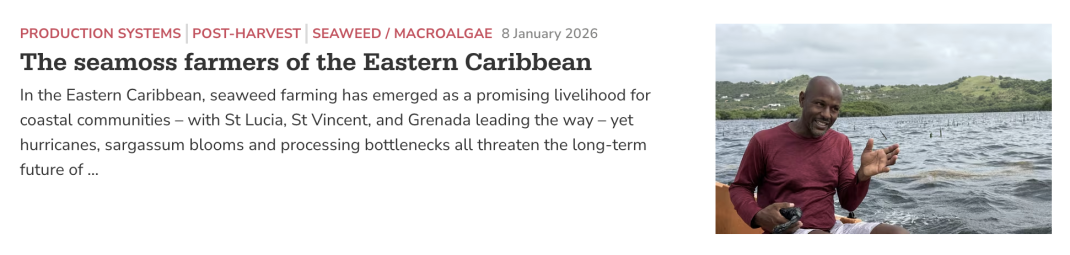
Click here to read The Fish Site article
Seaweed production by country
No. of farms by markets and countries
Farmed species
Regional production growth has been driven almost entirely by Eucheumatoid species.
Eucheumatoids

(primarily Kappaphycus alvarezii, marketed as “sea moss”)
While native species such as Gracilaria spp. and Eucheuma isiforme remain part of small-scale farming and were central to early cultivation efforts, their role in total output is now marginal, despite deep-rooted cultural traditions of seaweed use across the region.
Production by species
Eucheumatoids
This group of red algae forms the commercial backbone of the Caribbean seaweed industry. Output has risen sharply over recent decades, driven by expanding farming systems following the species’ 2008 introduction from the Philippines via Venezuela. Processed into dried seaweed and health-focused gels and drinks, it is prized for its carrageenan-rich gelling properties and is primarily marketed in premium niche markets in Europe and the USA.
The high level supply chain overview for Eucheumatoids
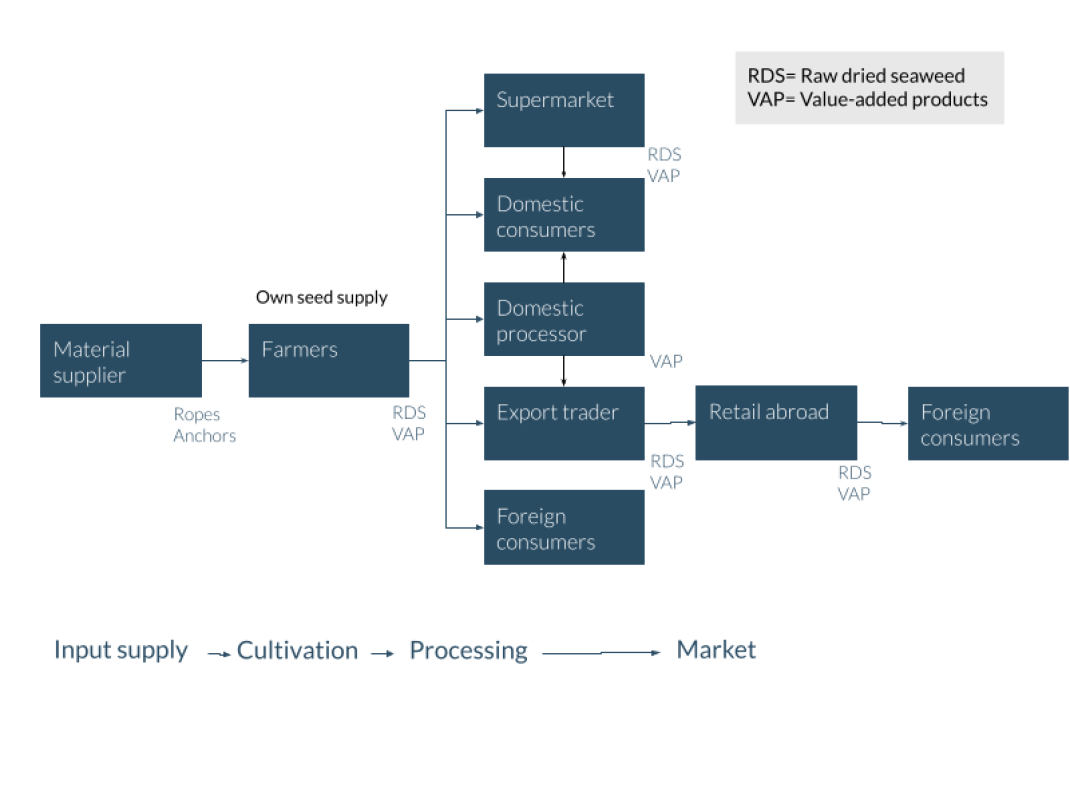
Input suppliers: Farmers make use of materials found in nature, as well as purchasing items not found in the wild, mainly ropes.
Farmers: These smallholders from Afrodescendant coastal communities farm seaweed either full-time or part-time and often develop value-added products such as gels, drinks, and shampoos to increase profitability. They can sell directly to customers, bypassing intermediaries, and also use both raw dried seaweed and value-added products for their own consumption.
Domestic consumers: Both national and international consumers purchase raw dried sea moss and value-added products domestically, often buying directly from farmers or processors at their homes.
Domestic processors: Raw dried sea moss is typically purchased for processing into value-added products destined for both domestic and export markets.
Export traders: They act as intermediaries, buying dried sea moss in bulk directly from farmers. They repackage products for retail outlets and foreign shops, and also trade value-added products for domestic and international markets.
Foreign consumers: They can either purchase it directly from farmers, arrange for it to be shipped to international locations via social media, or purchase it from shops that are supplied by export traders.
Retail: These are organic and natural stores in major cities across the USA and Europe, where sea moss products are sold at premium prices.
Explore the way Eucheumatoids are farmed step-by-step here
St Lucia
Overview
Seaweed farming began in Savannes Bay in the 1980’s , when the Ministry of Agriculture, Fisheries, Food Security and Rural Development provided information and training to interested parties. While Eucheuma denticulatum was the initial species introduced from the Philippines, Kappaphycus alvarezii, imported from Venezuela in 2008, has since become the most widely produced species.
The sector experienced significant growth in 2019, driven by a surge in demand for sea moss. Prior to 2019, production remained below 50 tonnes of wet weight. Since then, it has increased steadily, reaching a peak of 204.17 tonnes in 2021, with the most recent record of 147.83 tonnes in 2023.
Production sites
The main production sites are Praslin, Piaye, and Savannes Bay.
These sheltered bays offer:
- Calm, shallow waters
- Good water circulation
- Easy access from shore
These conditions are well suited to off-bottom and floating-line farming systems and support community-based production.
Governance
Seaweed farming in St. Lucia is a small-scale, community-based activity rooted in Afrodescendant coastal communities. Around 800 farmers are involved in the sector, and nearly half are women.
Women play a central role not only as farm workers, but also as processors, entrepreneurs, and leaders within farmer associations. Family members often participate across different stages of production and processing.
Seaweed farmers must register as mariculture producers with the Fisheries Department of the Ministry of Agriculture, Fisheries, Food Security and Rural Development. The ministry also issues licences for the use of coastal areas for farming.
To export seaweed, producers must obtain:
- Export authorisation from the ministry
- A phytosanitary certificate
While the regulatory system is clear, farmers can face delays linked to limited marine spatial planning and licensing capacity.
Support comes from national NGOs such as the Saint Lucia National Conservation Fund, and from international organisations including the Japan International Cooperation Agency, the Food and Agriculture Organisation of the United Nations, and the Global Environment Facility Small Grants Programme. These initiatives mainly focus on training and equipment for farmers.
St. Lucia has three main sea moss farmer associations:
- Eau Piquant Sea Moss Farmers Association
- Praslin Sea Moss Farmers Association
- Aupicon Sea Moss Farmers Association
These associations help farmers access permits, licences, training, and funding. They also enable collective investments in shared equipment, such as boats, which individual farmers could not afford alone. However, not all producers are registered members.
Future production outlook
Seaweed farming in St. Lucia is poised for growth but remains fragile, built on a foundation of high-quality "sea moss" and strong community-driven production. The sector benefits from premium market demand in the diaspora and tourism sectors, yet its potential is critically constrained by climate vulnerabilities—notably hurricanes and seasonal sargassum influx—and a fundamental lack of basic processing infrastructure.
Long-term sustainability and growth will depend on:
Investment in reliable drying and processing infrastructure
Clear marine spatial planning to resolve tenure and licensing bottlenecks
Strengthening of farmer cooperatives and market linkages
With targeted support in these areas, St. Lucia's seaweed sector can transform from a climate-sensitive livelihood into a resilient, value-added, and branded pillar of the island's blue economy.
St Vincente & the Grenadines
Overview
Seaweed farming began in Mayreau and Union Island in the early 2000s, introduced by women who had learned the practice in Grenada before bringing it to St. Vincent and the Grenadines. In 2020, the activity expanded to Canouan, where farmers from Union Island trained local residents. Initial cultivation focused on native Gracilaria species, but in 2008 Kappaphycus alvarezii was imported from Venezuela and has since become the dominant crop.
According to statistics provided by the Food and Agriculture Organization (FAO), seaweed production in St. Vincent and the Grenadines increased 54-fold between 2019 and 2020, reaching 13 tonnes wet weight. This volume remained unchanged through the most recent records in 2023. However, the 2024 Hurricane Beryl has severely impacted the sector, leading to a prolonged recovery period.
Production sites
The main production sites are the Grenadine islands of Canouan, Mayreau, Bequia, and Union Island.
These islands offer:
- Sheltered bays
- Clean, nutrient-rich waters
- Stable tropical marine conditions
Together, these factors support the production of high-quality sea moss. However, one year after Hurricane Beryl, many farmers have not yet restarted cultivation. Union Island currently hosts most of the active production, while other sites are still recovering.
Governance
Seaweed farming is a small-scale, community-based activity rooted in Afrodescendant coastal communities. Families are closely involved in farm work, processing, and marketing.
Women have played a pioneering role in the sector and continue to act as entrepreneurs, innovators, and leaders. They also encourage wider participation through community meetings and outreach activities, including visits to schools.
Permits and licences for seaweed farming are issued by the Fisheries Department of the Ministry of Agriculture, Lands, Forestry, Marine Resources and Cooperatives.
The ministry has mapped traditional farming areas and plans to increase production by developing new sites on the main island of St. Vincent. However, expansion is limited by scarce suitable locations, as the main island lacks a wide continental shelf. In contrast, the smaller Grenadine islands further south already have well-established sea moss farms.
Farmers receive support from international and regional organizations, mainly in the form of training and equipment. Key supporters include:
- Food and Agriculture Organization of the United Nations (FAO)
- Global Environment Facility Small Grants Programme
- Windward Aid
Additional regional support comes from institutions in Grenada, including the Ministry of Agriculture and the Grenada Development Bank, which provide business training and assist with export logistics.
The SeaMoss Association of St. Vincent & the Grenadines, established in 2023, is the country’s only seaweed farming association. It brings together farmers from several islands and currently includes 32 local members, two international members, and five youth members.
The association supports farmers by:
- Facilitating permits and licences
- Offering training and technical support
- Creating market linkages
- Coordinating exports
- Assisting with post-disaster recovery, including after Hurricane Beryl in 2024
Future production outlook
Seaweed farming in St. Vincent and the Grenadines is at a critical rebuilding stage, with recovery efforts shaping the sector’s future. The country has strong natural conditions, committed farmers, and growing organisational support, but the sector remains highly vulnerable to hurricanes, as highlighted by Hurricane Beryl.
Long-term resilience will depend on:
Investment in drying and processing facilities
Improved access to finance for small-scale farmers
Adoption of climate-resilient farming practice
With the right support, seaweed farming could grow into a stable source of income and export earnings, strengthening livelihoods across the Grenadine islands.
Grenada
Overview
Seaweed farming in Grenada began with a project by the Food and Agriculture Organisation of the United Nations, which assessed 12 value chains and identified sea moss as one of the top two. With FAO support, the Grenadian government developed an upgrading strategy centred on Kappaphycus alvarezii, providing training in production, processing, and marketing to strengthen and expand the sector.
According to the FAO, seaweed production in Grenada has demonstrated consistent growth since the first recorded data in 2015. The sector's output has been steadily increasing, reaching a peak of 25 tonnes wet weight in 2023.
Production sites
Sea moss farming in Grenada is concentrated in the southern and southeastern coastal areas, with the main production centered on bays such as True Blue, Fort Jeudy, Bailey’s Bacolet, Corinth, Grenville, and Telescope, as well as along beaches including Paradise, Pearls, and Gouyave.
These sites offer:
- Shallow, clear, and unpolluted waters
- Warm temperatures year-round
- Natural shelter from offshore reefs that reduce wave action
Sufficient water movement for nutrient exchange
Together, these conditions support high-quality sea moss production.
Governance
Seaweed farming in Grenada is a small-scale, community-based activity rooted in Afrodescendant coastal communities. Families are closely involved in farming and processing activities.
The sector includes more than 100 farmers, and around 45% are women. This level of female participation is significantly higher than in other agricultural sectors, such as soursop farming. Women have been key drivers of value-added products, including creams, scrubs, shampoos, and gels.
Farmers must be registered as sea moss producers with the Fisheries division of the Ministry of Agriculture and Lands, Forestry, Marine Resources and Cooperatives.
To export seaweed, producers must obtain:
- Export authorization from the ministry
- A phytosanitary certificate
The ministry also mapped areas suitable for seaweed farming, avoiding protected marine areas and locations used for other activities, and assigned licences according to that.
The Fisheries Division now operates under the Ministry of the Blue Economy, strengthening coordination across marine sectors. The FAO continues to provide technical guidance, and farmer communication is supported through a dedicated WhatsApp group.
Additional support comes from the Grenada Sustainable Development Trust Fund and the Grenada Development Bank through training and financial assistance. International programs from the United Nations, including United Nations Environment Programme (UNEP), the United Nations Development Programme (UNDP), and potentially the Caribbean Regional Fisheries Mechanism (CRFM) also provide training support.
The sea moss farmers association supports producers by facilitating permits and licences, while working to establish a centralized drying facility to ensure consistent quality. It also strengthens farmers’ negotiating power, preventing exploitation by buyers, and promotes joint marketing. Associations further enhance communication and collaboration, enabling farmers to share resources, experiences, and information more effectively.
Future production outlook
Seaweed farming in Grenada is poised for growth, backed by strategic government support and innovative, women-led value addition. This potential, however, is balanced against persistent hurdles including inconsistent product quality, limited processing infrastructure, site-use conflicts, and recurrent hurricane damage.
Long-term sustainability and growth will depend on:
Expanding training for climate-resilient & deep-water farming techniques
Implementing effective marine spatial planning to resolve conflicts
Fostering quality control through centralized processing facilities
By addressing these needs, seaweed farming can solidify its role in Grenada’s food security and coastal community development, evolving into a more robust and sustainable blue economy sector.