Seaweed
  • Species production
  • Regional production
  • About
  • Reports
  • en
  • es
  • pt
  • Species Production Overview
  • Eucheumatoids
  • Saccharina
  • Undaria
  • Pyropia
  • Gracilaria
  • Macrocystis
  • Global Production Overview
  • East Asia
  • South East Asia
  • Central America & Caribbean
  • South America
  • Species production
    • Species Production Overview
    • Eucheumatoids
      • Production Overview
      • Site selection
      • Farm design
      • Seeding
      • Grow out
      • Harvest
      • Post harvest
      • Sales
      • The farmer
      • Future of farm
    • Saccharina
      • Production Overview
      • Site selection
      • Farm design
      • Seeding
      • Grow out
      • Harvest
      • Post harvest
      • Sales
      • The farmer
      • Future of farm
    • Undaria
      • Production Overview
      • Site selection
      • Farm design
      • Seeding
      • Grow out
      • Harvest
      • Post harvest
      • Sales
      • The farmer
      • Future of farm
    • Pyropia
      • Production Overview
      • Site selection
      • Farm design
      • Seeding
      • Grow out
      • Harvest
      • Post harvest
      • Sales
      • The farmer
      • Future of farm
    • Gracilaria
      • Production Overview
      • Site selection
      • Farm design
      • Seeding
      • Grow out
      • Harvest
      • Post harvest
      • Sales
      • The farmer
      • Future of farm
    • Macrocystis
      • Production Overview
  • Regional production
    • Global Production Overview
    • East Asia
    • South East Asia
    • Central America & Caribbean
    • South America
  • About
  • Reports
Seaweed
  • en
  • es
  • pt
  • Production Overview
  • Site selection
  • Farm design
  • Seeding
  • Grow out
  • Harvest
  • Post harvest
  • Sales
  • The farmer
  • Future of farm

Undaria Harvest

Table of contents
  • East Asia
    1. Overview

    2. Harvest

    3. Transportation of biomass

East Asia

Overview

Harvesting only takes place a few months a year, between February and April, and is therefore an intensive and crucial period for the farmers.

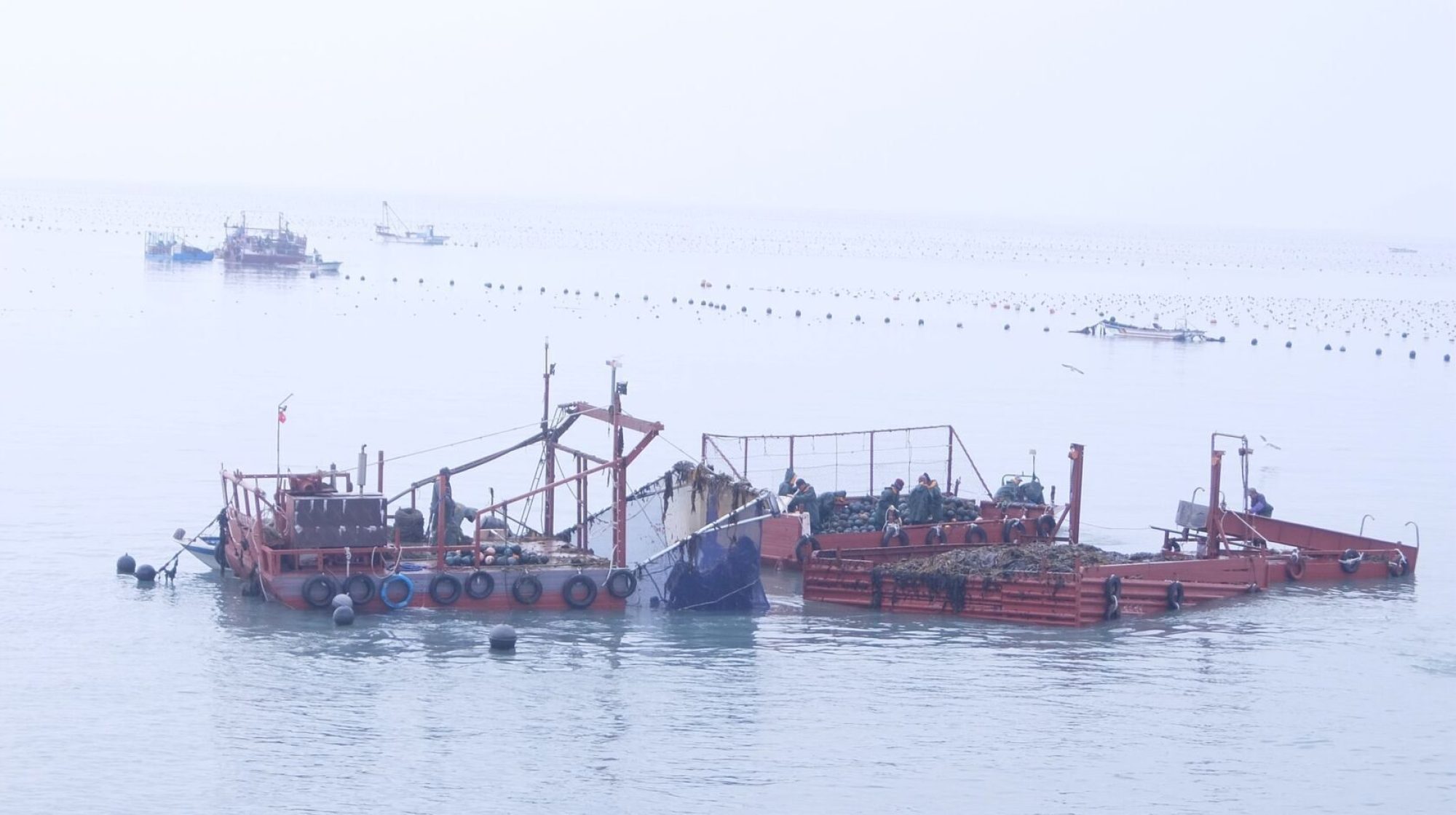
Harvesting Undaria in South Korea with a semi-automated continuous process strips all seaweed from the line.
Harvesting in Goheung-gun, Jeollanam-do, South Korea. (Photo courtesy of Riken Food)

Harvest

In January, some farmers start partially harvesting to adjust density, however main harvesting will usually begin in February and can go on until the end of April. The Undaria blades are harvested when they reach approximately 1.5 to 2 metres in length.


In Dalian, China, farmers harvest the blades when they reach 1 metre and sometimes harvest a second time a couple of months later. Before 2010 Undaria would be harvested three to four times a year in Dalian.
 

The harvesting period can go on until the end of April, depending on the sea temperature and crop conditions. Since in many regions Undaria is farmed for abalone feed, farmers try to extend the harvesting period as much as possible, sometimes until May. At this point, the warming water temperatures cause the tissue of the blades to erode, but this is not problematic when the seaweed is used as abalone feed.


Culture lines are typically removed from site after harvest and maintained ashore.
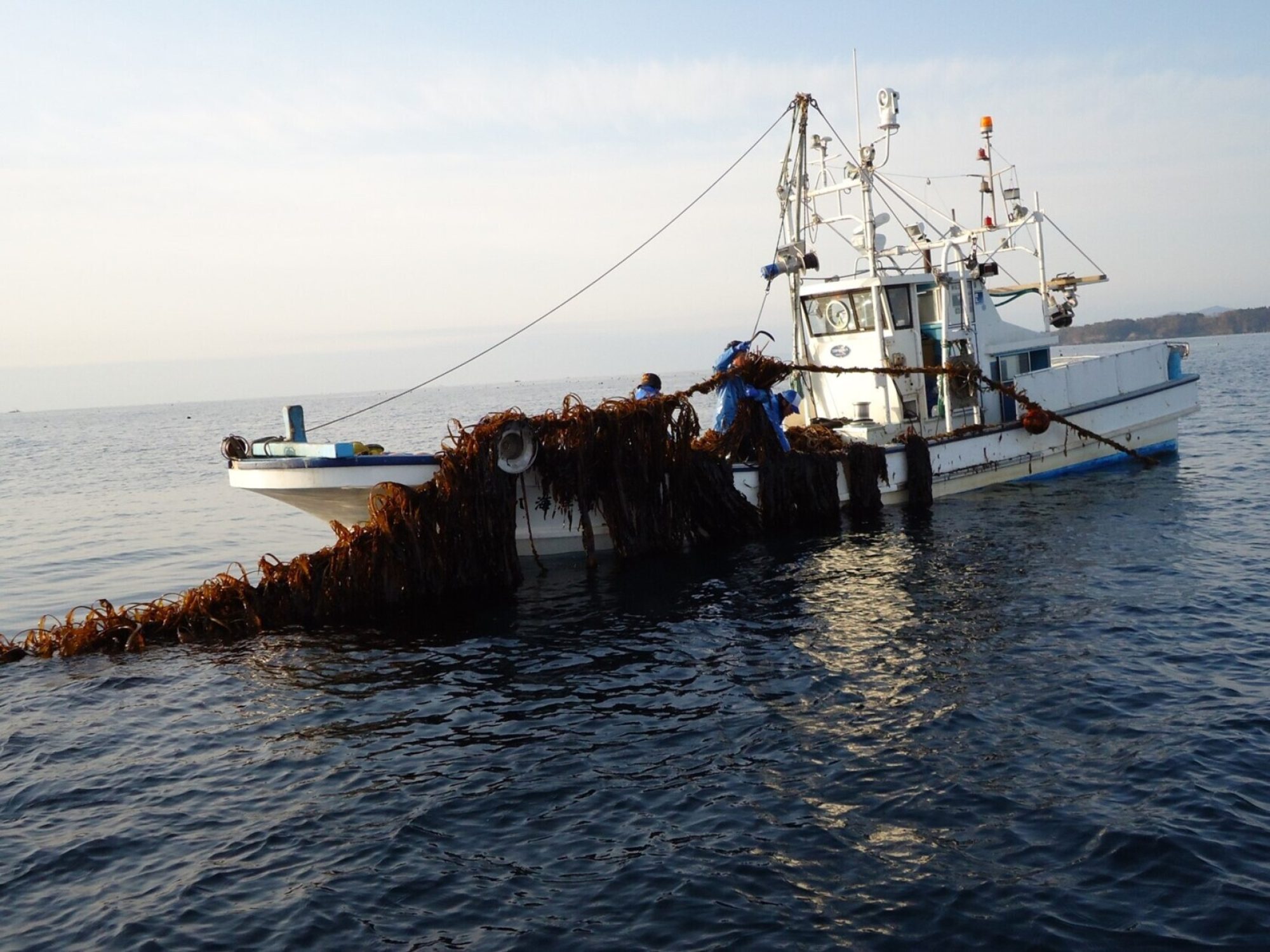
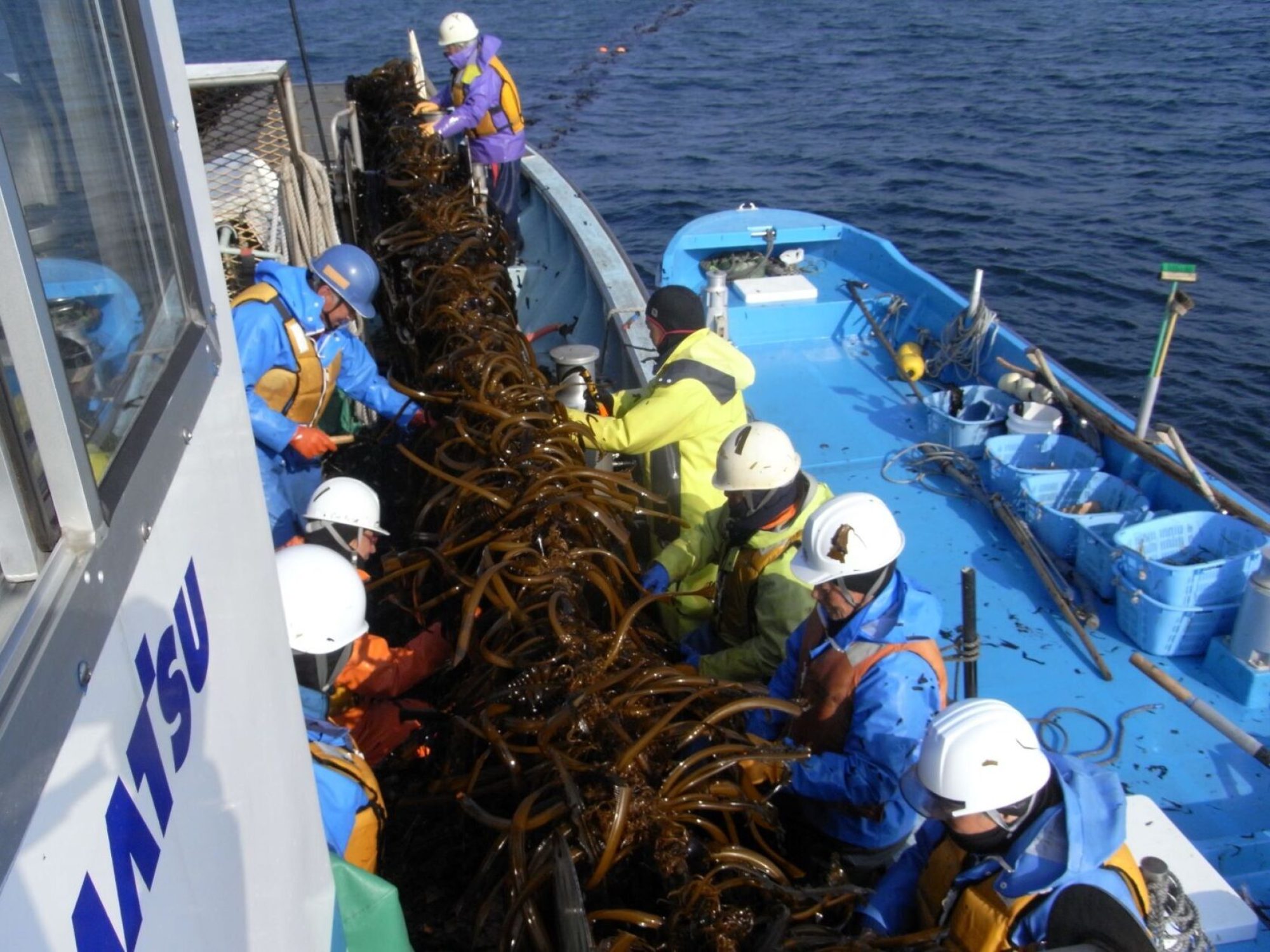
A harvesting boat from a Fishery cooperative in Sanriku, Japan. With this method approximately 150 meters of line is harvested per hour.(Photo courtesy of Riken Food)
In Japan, a Fishery cooperative typically has one large harvesting boat, where all members works together during harvest season. (Photo courtesy of Riken Food)
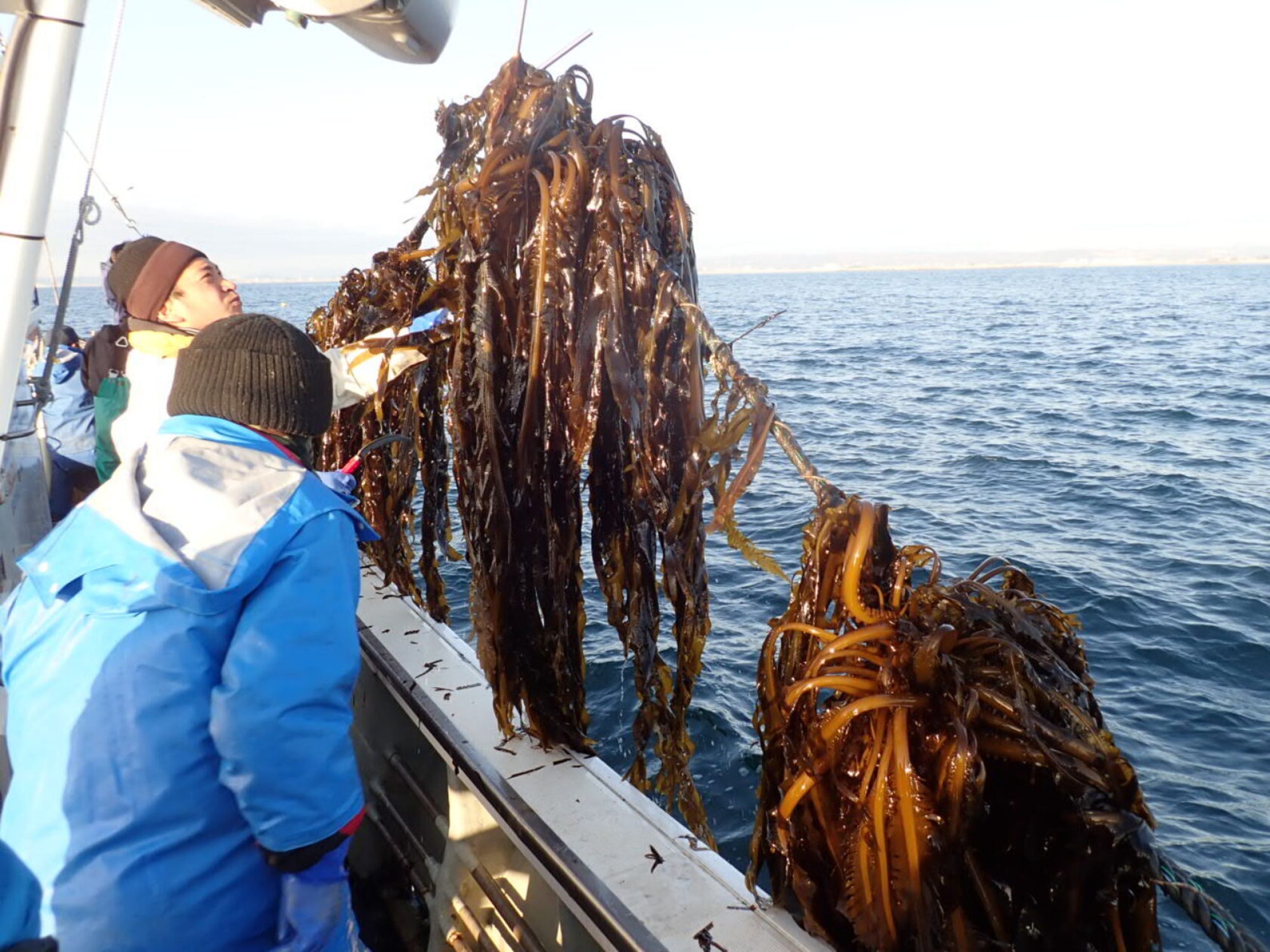
In Iwate and Miyagi Prefectures in Japan, the cutting takes place at the top of the Sporophyll. (Photo courtesy of Riken Food)
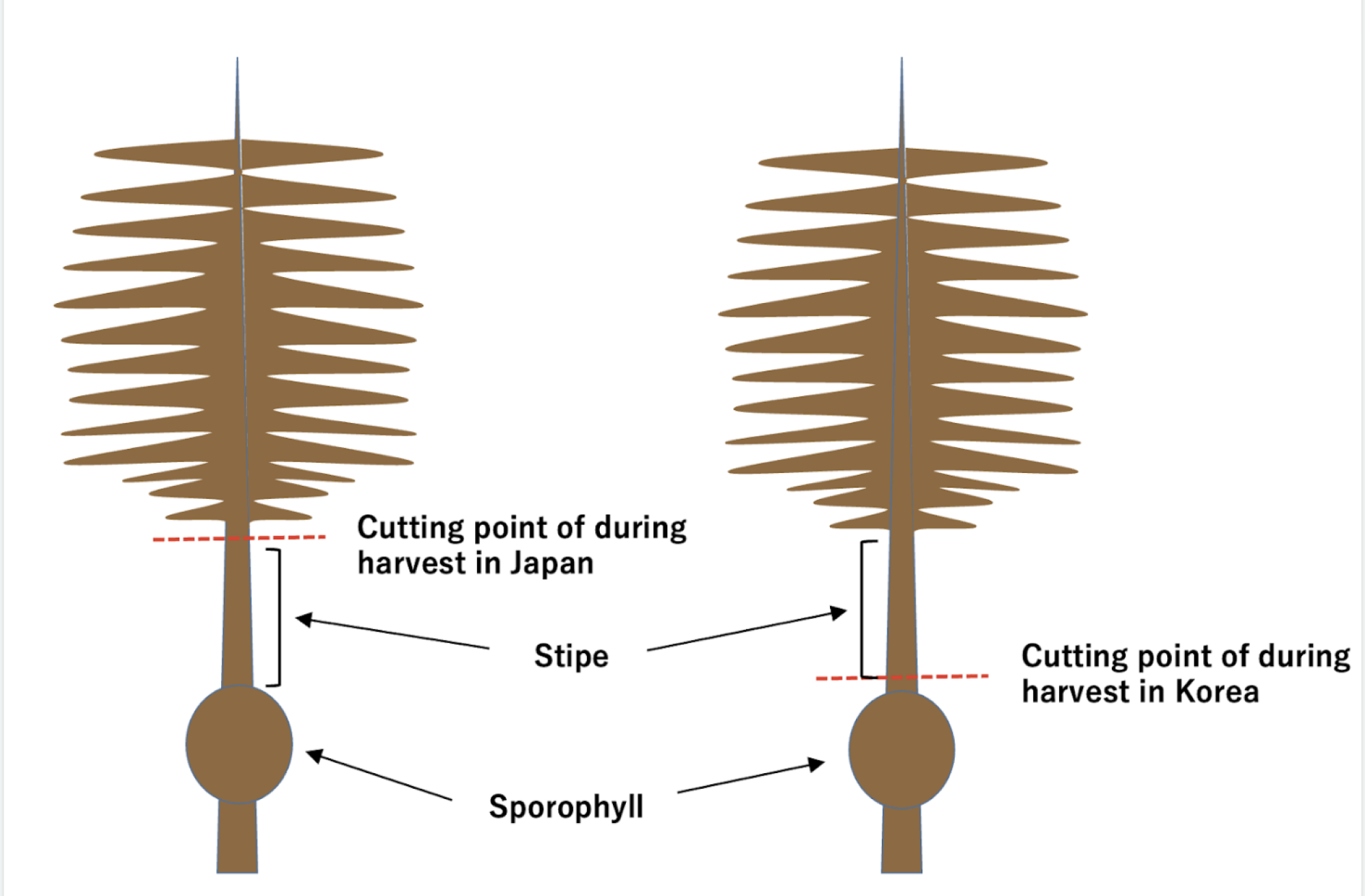
The cutting point is very different between South Korea and Japan. (Illustration from Riken Food)

The eroded tissues, including lower stipes are usually cut off if the seaweed is destined for human consumption. In Iwate and Miyagi Prefectures in Japan, the long stipes are not included, while in South Korea the cutting point is just above the Sporophyll. Such differences should  be taken into account when comparing yields.

Transportation of biomass
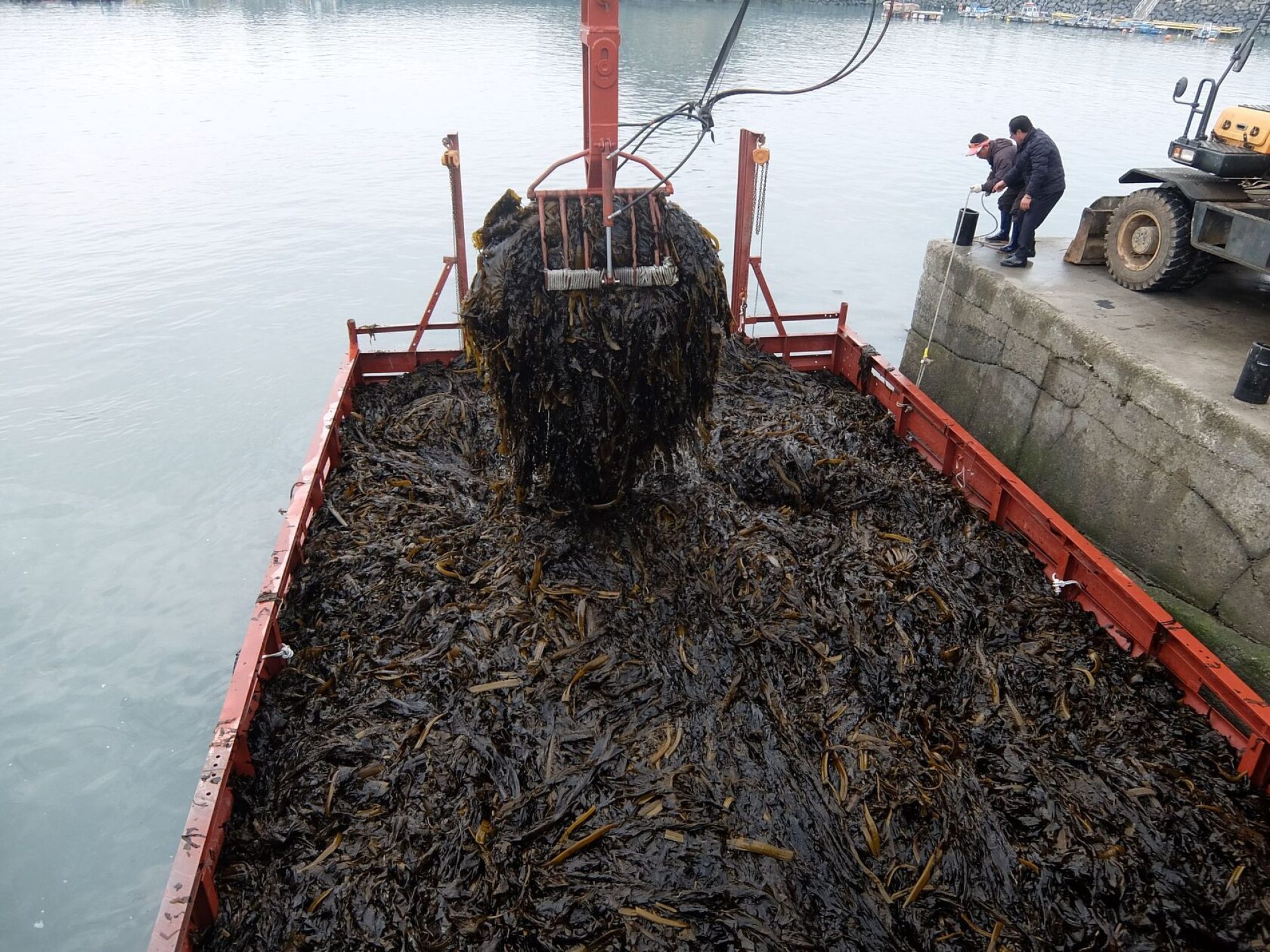
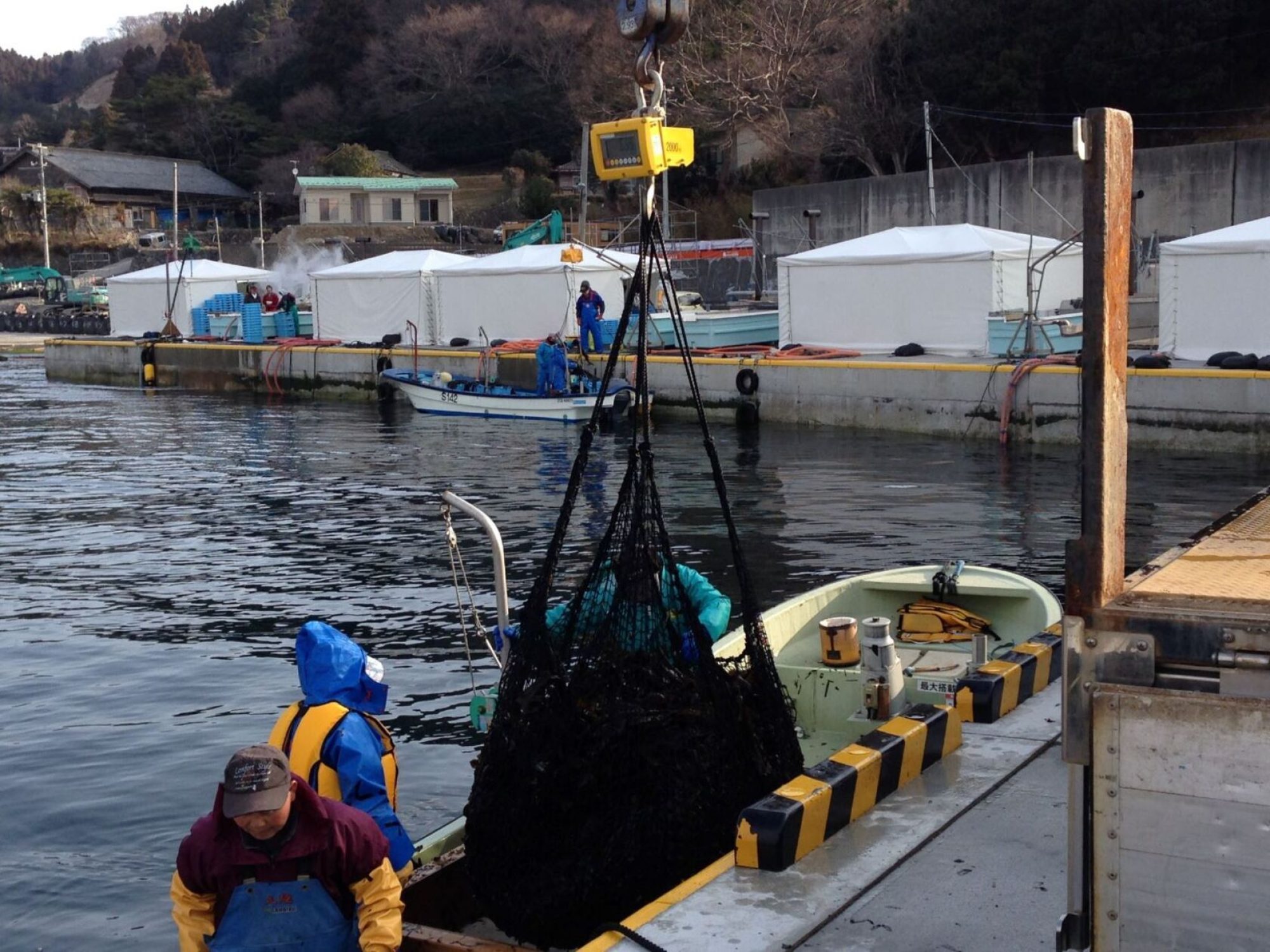
Lifting the harvested biomass from the barge boat to pier in Goheung-gun, South Korea. (Photo courtesy of Riken Food)
Transportation of harvested Undaria to shore in Sanriku, Japan. (Photo courtesy of Riken Food)

In South Korea, different harvesting methods can gather between 600 and 3,000 metres per hour. Yet it is important to note that the fastest method,  stripping the entire lines with a semi-automated continuous process, significantly affects the quality of the harvested seaweed.


In Japan, a fishery cooperative typically owns one large harvesting boat, where all member farmers work together during harvesting season. With this method approximately 150 metres of grow line can be harvested per hour. 


In China, harvesting boats are typically smaller and manned by two people.The cutting is done manually with the support of a crane on board. One boat with two people can harvest about 200 metres of culture line per hour.

Previous
Next
Seaweed

Contact us:

info@hatch.blue
www.hatch.blue

Copyright © 2026 Hatch Blue Limited. All rights reserved.

  • Terms and conditions
  • Privacy policy

Hatch Blue is a global impact business focussed on farmed and alternative seafood. Hatch Innovation Services is the consultancy arm of Hatch, advising corporates, investors and governments on innovation and investment projects in the global aquaculture industry.

For our Shrimp Farming Insights visit: www.shrimpfarm.tech.