Seaweed
  • Species production
  • Regional production
  • About
  • Reports
  • en
  • es
  • pt
  • Species Production Overview
  • Eucheumatoids
  • Saccharina
  • Undaria
  • Pyropia
  • Gracilaria
  • Macrocystis
  • Global Production Overview
  • East Asia
  • South East Asia
  • Central America & Caribbean
  • South America
  • Species production
    • Species Production Overview
    • Eucheumatoids
      • Production Overview
      • Site selection
      • Farm design
      • Seeding
      • Grow out
      • Harvest
      • Post harvest
      • Sales
      • The farmer
      • Future of farm
    • Saccharina
      • Production Overview
      • Site selection
      • Farm design
      • Seeding
      • Grow out
      • Harvest
      • Post harvest
      • Sales
      • The farmer
      • Future of farm
    • Undaria
      • Production Overview
      • Site selection
      • Farm design
      • Seeding
      • Grow out
      • Harvest
      • Post harvest
      • Sales
      • The farmer
      • Future of farm
    • Pyropia
      • Production Overview
      • Site selection
      • Farm design
      • Seeding
      • Grow out
      • Harvest
      • Post harvest
      • Sales
      • The farmer
      • Future of farm
    • Gracilaria
      • Production Overview
      • Site selection
      • Farm design
      • Seeding
      • Grow out
      • Harvest
      • Post harvest
      • Sales
      • The farmer
      • Future of farm
    • Macrocystis
      • Production Overview
  • Regional production
    • Global Production Overview
    • East Asia
    • South East Asia
    • Central America & Caribbean
    • South America
  • About
  • Reports
Seaweed
  • en
  • es
  • pt
  • Production Overview
  • Site selection
  • Farm design
  • Seeding
  • Grow out
  • Harvest
  • Post harvest
  • Sales
  • The farmer
  • Future of farm

Pyropia Grow out

Table of contents
  • East Asia
    1. Overview

    2. Maintenance

    3. Technology use

East Asia

Overview

The grow out period of Pyropia starts around October when the seawater temperature drops below 23°C and multiple harvests can be taken from a single seeding throughout the winter months.

Maintenance
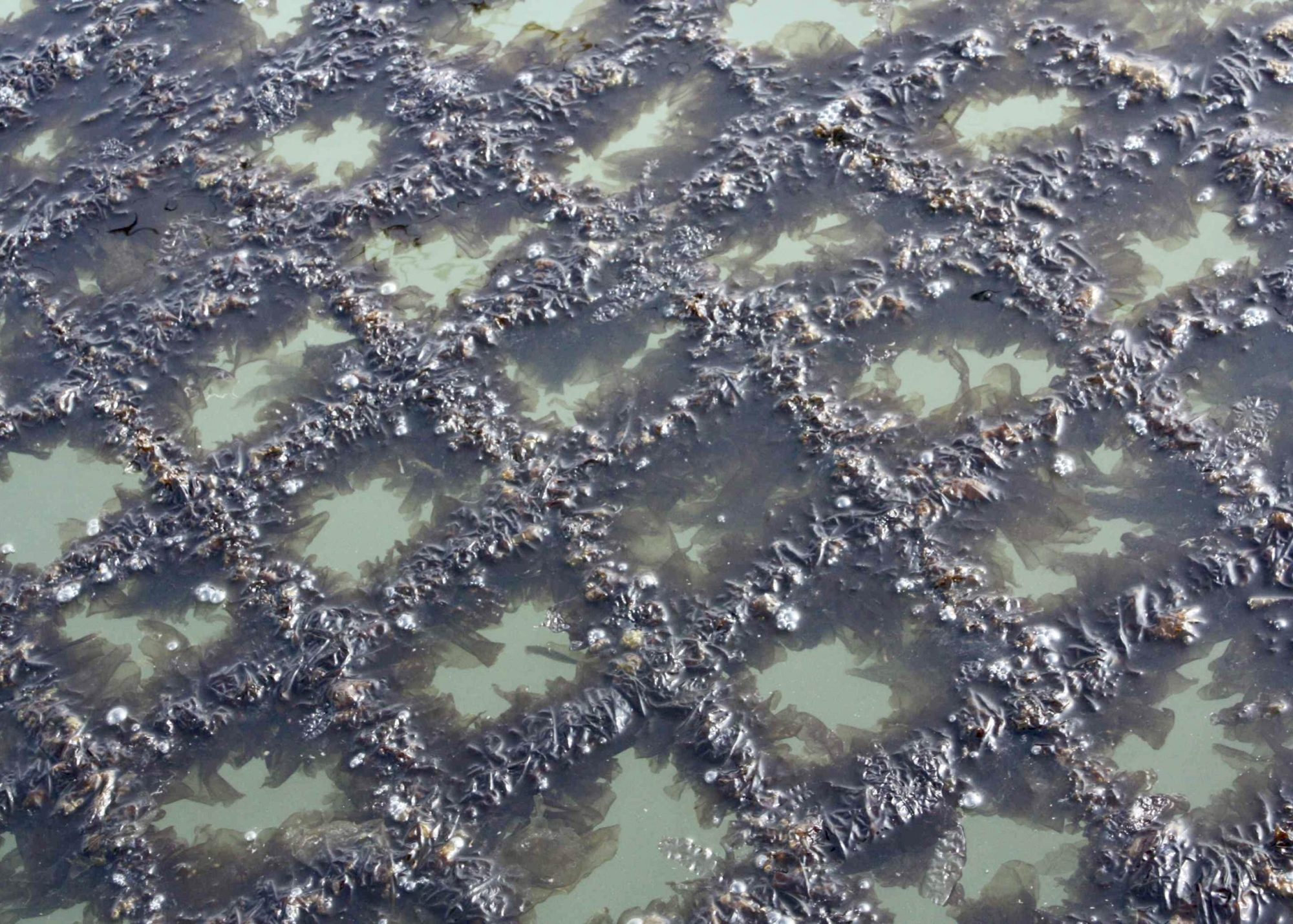
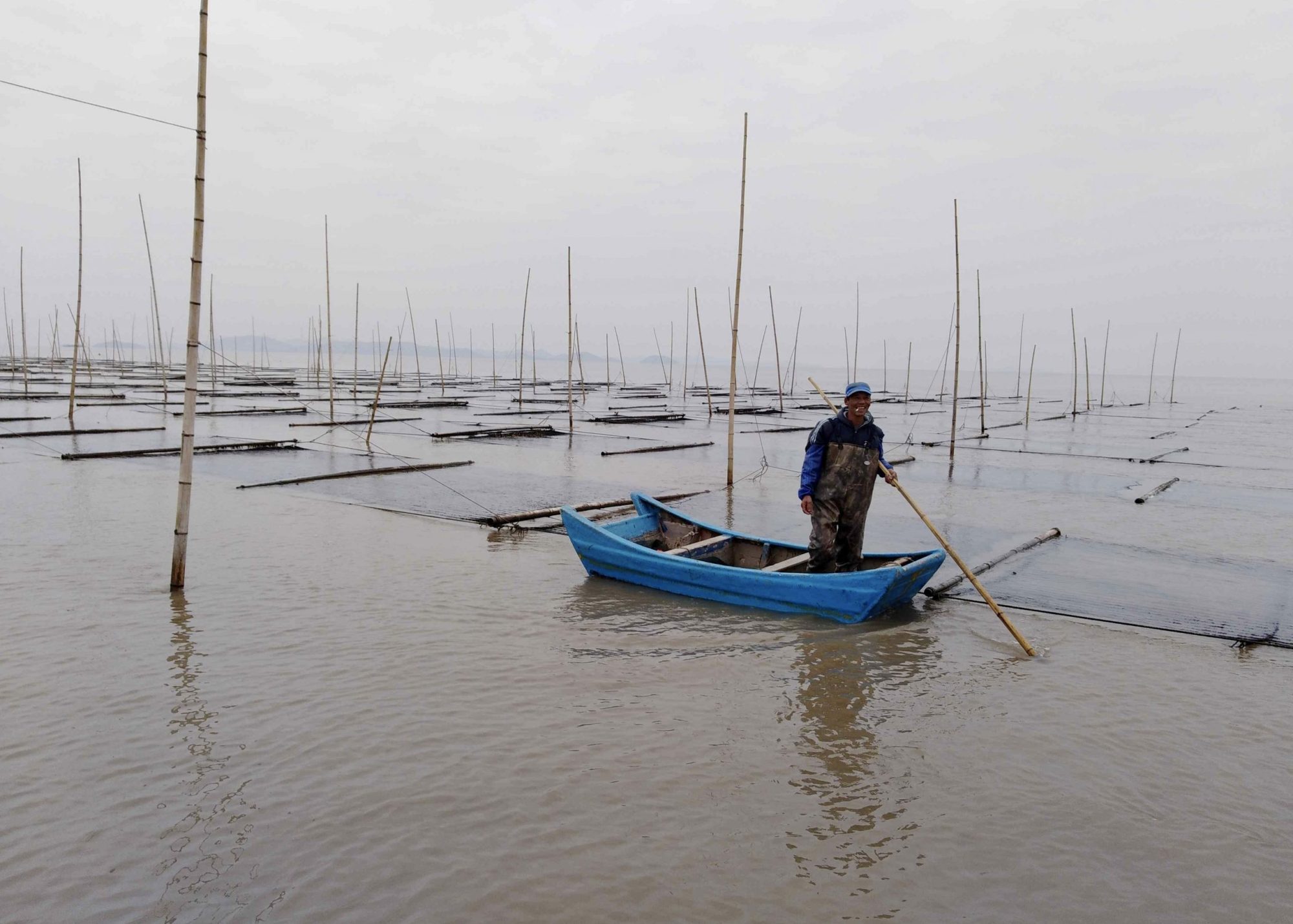
Grow out on culture nets in South Korea. (Photo courtesy of Dr Hwang EK)
Farming checking on culture nets in Jiantsu, China. (Photo courtesy of Li-En Yang)

In the fixed net or fixed pole method and the semi-floating method, the tide fluctuation naturally exposes the cultivation nets to the air for a period of time every day. This improves growth and quality of the crop and reduces contamination from other algae.


Cultivation with fully floating nets keeps the Pyropia submerged in the water during both high and low tides and the farmer has to flip the nets over for a few hours every 4-5 days to ensure air exposure. This is very labour intensive work. In South Korea, a floating net method was developed that flips the nets over automatically using the tidal cycle (floating turnover net method or flip-over floating net method). This method was also employed in China, but the flip-over is not fully automated yet.
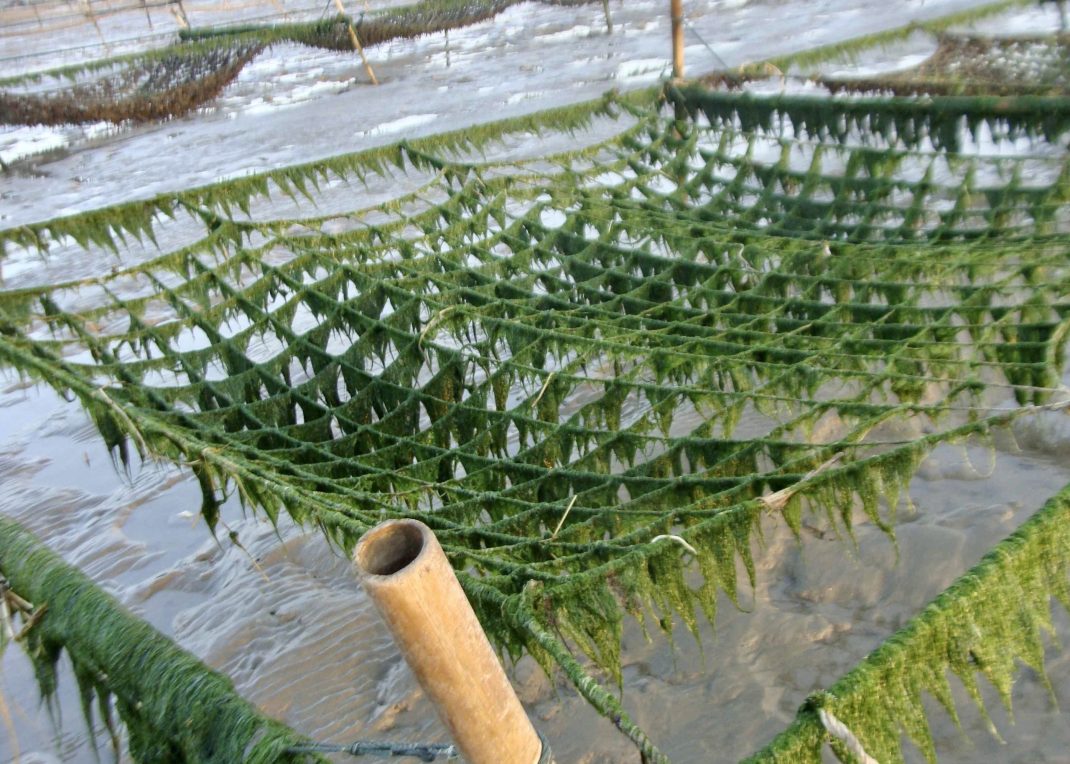
Green algae attaching to culture nets and overgrowing Pyropia in China. (Photo courtesy of Li-En Yang)

Nutrient depletion, especially lack of nitrogen in seawater, causes a chlorosis-like phenomenon that is called “yellow bleaching”. The farmers can anticipate this phenomenon by seeing clear seawater instead of the usual turbidity.


In South Korea and Japan, using an organic citric acid-based fertiliser treatment between harvesting operations is common practice. Harvesting and treating usually takes place at the same time or at least during the same process.


During grow out, the young Pyropia plants are especially susceptible to diseases and changing water conditions. Farmers can usually tell from their experience and intuition favourable from unfavourable conditions.

Technology use

  • In South Korea, environmental water quality controls are carried out by the government every 2 months, which measure among other things the iodine, nitrogen and phosphorus content.


  • In Japan, farmers reported that they use portable sensors for temperature, pH and salinity every now and then.


  • In China, it is not typical for farmers to monitor and measure seawater conditions regularly.
Previous
Next
Seaweed

Contact us:

info@hatch.blue
www.hatch.blue

Copyright © 2026 Hatch Blue Limited. All rights reserved.

  • Terms and conditions
  • Privacy policy

Hatch Blue is a global impact business focussed on farmed and alternative seafood. Hatch Innovation Services is the consultancy arm of Hatch, advising corporates, investors and governments on innovation and investment projects in the global aquaculture industry.

For our Shrimp Farming Insights visit: www.shrimpfarm.tech.