South America
Overview
Seaweed farming in South America historically has been dominated by Chile, which accounted for most of the regional output thus far. However, the industry is starting to diversify, with Venezuela showing rapid growth since 2019. Brazil maintains a smaller, increasing presence, traditionally in Rio de Janeiro, but with recent growth in Santa Catarina.
Seaweed production by country
No. of farms by markets and countries
Seaweed production: volume and value
Farmed species
South America’s farmed seaweed production has led by Gracilaria while Eucheumatoid species are now driving emerging industries.
Gracilaria
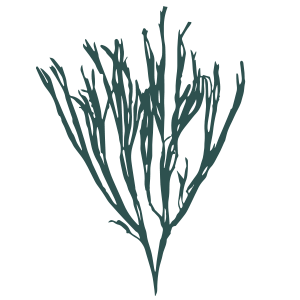
(Agarophyton chilense)
Eucheumatoids

(Kappaphycus alvarezii)
Production by species
Gracilaria
Gracilaria has long dominated South America’s farmed seaweed sector, though production has declined sharply from its 1990s peak to about 14,000 tonnes in 2023. Cultivated mainly in Chile for high-quality agar, it relies on simple bottom-based systems highly vulnerable to pests and green-tide events, despite producing agar with exceptional gel strength.
The high level supply chain overview for Gracilaria
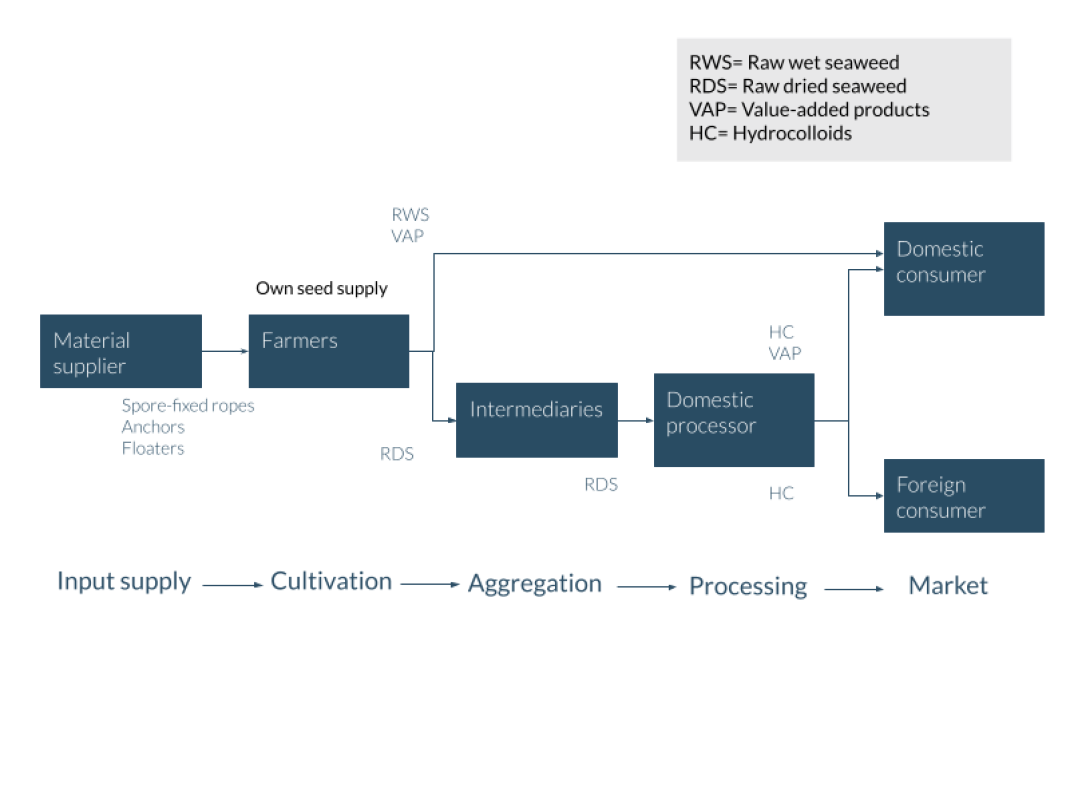
Input suppliers: Specialised hatcheries such as Algas Marinas and the Huiro Regenerativo program produce spore-fixed ropes and plantlets for Gracilaria chilensis and Macrocystis pyrifera cultivation, while general local suppliers provide essential materials like ropes, PVC, and reused flotation devices.
Farmers: Smallholders from traditional coastal communities farm seaweed part-time to supplement income from fishing and seasonal work. Some produce value-added foods and snacks for higher returns, selling to local consumers and hospitality markets.
Intermediaries: Middlemen purchase raw dried seaweed directly from farmers at landing sites, aggregating volumes for resale to processing plants or exporters, often capturing significant margins while offering producers low prices.
Domestic processors: Companies such as Algas Marinas (agar), Gelymar (carrageenan), Patagonia Biotecnología (biofertilizers), and Seaweed Place (food products) transform raw seaweed into high-value hydrocolloids and value-added products, driving demand and innovation in the sector.
Domestic consumers: The general public consumes raw wet seaweed products such as cochayuyo and luche, while the HORECA sector and the agricultural industry purchase value-added products, including processed foods and biostimulants. A small domestic industrial segment also sources hydrocolloids.
Foreign consumers: Global hydrocolloid buyers such as Cargill and IFF purchase large volumes of refined agar and carrageenan for industrial use, while Asian markets import dried Lessonia and Durvillaea for food, and specialized VAPs are exported to Europe and the United States.
Explore the way Gracilaria is farmed step-by-step here
Eucheumatoids
Eucheumatoids form a non-native, emerging cultivation sector in Brazil and Venezuela. Production expanded rapidly after 2018, peaked in 2020, and has since declined, reflecting market volatility. While used for carrageenan, most output, especially in Brazil, feeds high-value agricultural biostimulant markets, with labour-intensive coastal farming constrained by seasonality and a shift toward processed products.
The high level supply chain overview for Eucheumatoids
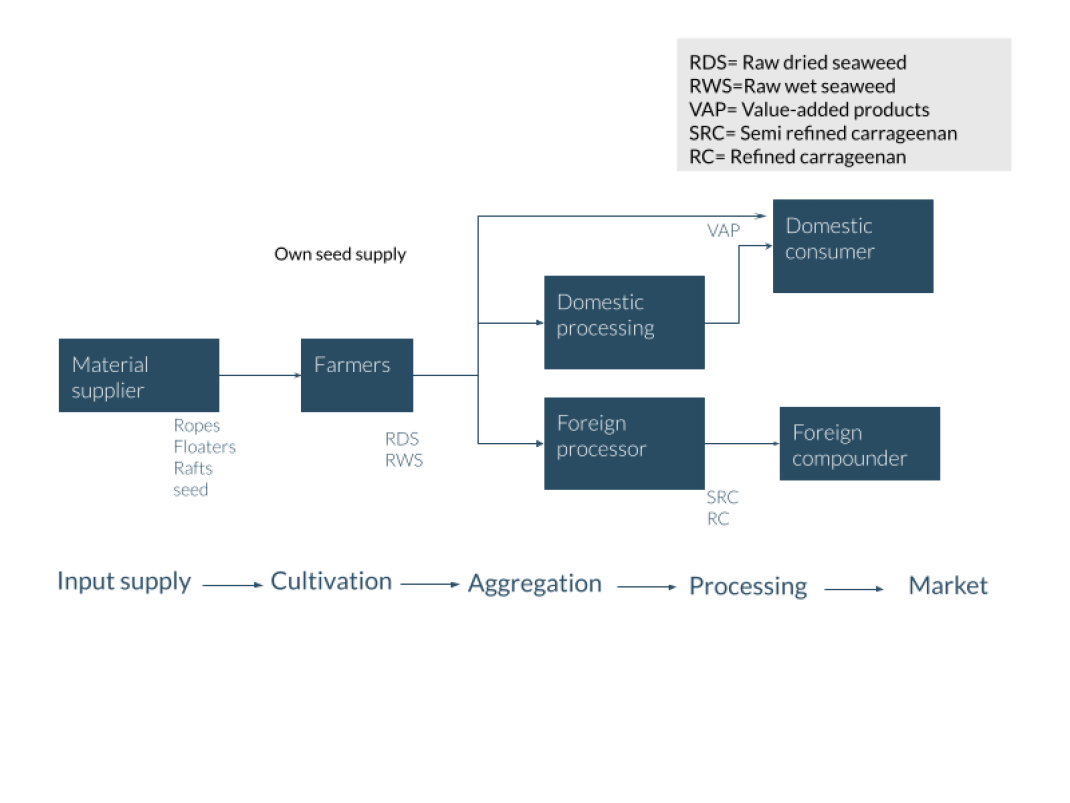
Material Suppliers: Local or international companies that provide essential cultivation materials, such as ropes (polyethylene/polypropylene), PVC pipes, and flotation devices.
Seed Suppliers: Primarily the farmers themselves, who maintain their own vegetative seedstock through clonal propagation. This group also includes regional networks and research institutions (e.g., UFSC in Brazil) that develop, store, and distribute selected algal strains.
Farmers: Coastal community members, often fishing families, who farm seaweed part-time on small, independent plots.
Integrative Farms (Venezuela Model): Larger, organized enterprises that employ farmers full-time and operate their own cultivation units. They also act as central aggregators, purchasing RWS from neighboring independent farmers and processing it.
Domestic Processors: Companies that transform RWS into Value-Added Products (VAP), primarily liquid agricultural bio-stimulants, for the regional market.
Foreign Processors: International companies, often located in Chile or Asia, that purchase RDS to extract Semi-Refined (SRC) or Refined Carrageenan (RC).
Foreign Compounders: Global manufacturers who purchase SRC/RC to use as ingredients in final blends for the food, pharmaceutical, and cosmetic industries worldwide.
Explore the way Euchematoids are farmed step-by-step here
Chile
Overview
Chile’s seaweed industry is grounded in the ancestral practices of Indigenous coastal communities, who have used native species for millennia. The country is still the largest producer of wild harvested seaweed globally, with a high diversity of species being extracted and holds a key place in the global ranking of hydrobiological product suppliers, ranking 11th worldwide in aquaculture seaweed production.
Unlike other Latin American producers, Chile’s cultivation portfolio relies exclusively on native macroalgae. Commercial cultivation expanded in the 1980s with the rise of Agarophyton chilense (Gracilaria) farming in response to declining natural beds, and it remains the country’s principal cultivated species. Another important commercial species, Macrocystis pyrifera is currently farmed by two companies at two sites.
Chile’s Gracilaria farming sector has become highly volatile. After peaking in the 1990s, production collapsed, then partially rebounded, supported by subsidies, to 21,672 tonnes in 2019, before falling again to 14,426 tonnes in 2023 due to pest pressure, clonal seedstock degradation, and weak agar prices. Farmed volumes remain marginal: 97% of Chile’s seaweed supply still comes from wild harvesting, with only 3% from cultivation.
Chile’s seaweed supply remains overwhelmingly wild-based, dominated by Gracilaria and Macrocystis pyrifera, which underpin the hydrocolloids industry. Pyropia and native species such as Sarcothalia and Sarcopeltis contribute minimally.
Production sites
Gracilaria farming is concentrated in the Los Lagos region, especially in sheltered estuaries such as Río Maullín and Río Pudeto. These areas offer:
- Brackish, nutrient-rich waters
- Soft sediments suitable for planting
- Calm conditions for intertidal and shallow sub-tidal farming
Macrocystis pyrifera farming remains experimental. Pilot sites such as Faro Corona are often located near salmon farms, where nutrient-rich effluents support kelp growth. These projects are part of emerging Integrated Multi-Trophic Aquaculture (IMTA) systems, where seaweed helps absorb excess nutrients.
Governance
Chile’s seaweed farming sector remains small-scale and community-based, centred on a single agar processor that informally supplies seedstock. An aging workforce and labour-intensive intertidal work have created a generational gap as youth seek alternative jobs. Training programs and regenerative ventures like Huiro Regenerativo aim to attract younger farmers, while rising women’s participation highlights the need for stronger social data.
Seaweed farming in Chile is governed by the General Law of Fishing and Aquaculture, the National Aquaculture Policy, and the Bonification Law for Algae Cultivation. Together, these frameworks provide clear rules for seaweed farming, including biosecurity requirements and community management mechanisms. However, key challenges remain:
- Limited marine spatial planning
- Weak support for seed development and hatcheries
- Few incentives for long-term or IMTA investments
Legally recognised tenure rights are issued by the Subsecretaría para las Fuerzas Armadas (SSFFAA). The permitting pathway is highly complex and can take 8–10 years, requiring coordination with the Subsecretaría de Pesca y Acuicultura (SUBPESCA) for regulatory authorization, the Servicio de Evaluación Ambiental (SEA) for environmental assessments in larger projects, and the Servicio Nacional de Pesca y Acuicultura (SERNAPESCA) for sanitary compliance.
Farmers and companies must obtain:
Aquaculture Concession (CCAA)
Environmental & Sanitary Permits
Operational & Commercial Registration
Cultivation can also occur in Areas for Management and Exploitation of Benthic Resources (AMERB), managed by artisanal fisher unions (limited to 40% of the area), or within Marine Coastal Spaces for Indigenous Peoples (ECMPO).
Support for Chilean seaweed farmers comes through a multi-tier system of public and private initiatives:
- The Bonification Law subsidizes production costs for artisanal farmers.
- CORFO-backed programs, including Huiro Regenerativo, support hatchery development and improved harvesting methods.
- Government agencies and NGOs provide training in cultivation, business management, food safety, and small-scale processing.
These efforts aim to increase value addition and improve farmer incomes.
Future production outlook
Chile’s seaweed sector has strong potential for modernisation and value creation, supported by extensive coastline biodiversity, established research institutions, and a structured regulatory framework. However, long-term growth and commercial scalability are limited by critical challenges, including a prohibitively complex licensing system, degraded seed quality with recurrent pest outbreaks, and an economically unsustainable model focused on low-value raw exports.
Long-term resilience and growth will depend on:
Streamlining the concession process and creating algae-specific regulations.
Investing in modern hatcheries and robust biosecurity protocols.
Shifting to high-value products and reforming financial incentives to support producer autonomy
By addressing these priorities, the sector can overcome systemic barriers, stabilise producer livelihoods, and evolve into a competitive, innovative, and sustainable pillar of Chile’s blue economy.
Venezuela
Overview
Seaweed farming in Venezuela began in the late 1980s with mariculture projects growing Gracilaria cornea and Gracilariopsis tenuifrons. These early efforts were led by the company Geles del Caribe (GELCA). In 1996, the company BIOTECMAR introduced Kappaphycus alvarezii and Eucheuma denticulatum from the Philippines. Today, Kappaphycus alvarezii is the main species farmed in the country.
Venezuela’s seaweed sector has grown quickly since 2019. Production peaked at 2,006.8 tonnes in 2022, then declined in the following years. Despite this variability, Venezuela is now Latin America’s second-largest seaweed producer after Chile. Between 2019 and 2023, the country exported 3,853 tonnes of dried seaweed, mainly to international markets.
Production sites
Seaweed farming in Venezuela is concentrated along the northeast Caribbean coast, especially around the islands of Margarita, Cubagua, and Coche in Nueva Esparta state.
These areas benefit from:
- Coastal upwelling that brings nutrients to surface waters
- Warm temperatures and high salinity
- Clear water with strong sunlight
- Sheltered bays and shallow coastal areas
Together, these conditions support fast growth and relatively low farming costs for tropical seaweed species.
Governance
In Venezuela, seaweed farming blends commercial and small-scale production. Three major integrative companies lead the sector: TIDE, which collaborates with more than 350 small-scale producers, and BIOMAR and Seaweed Revolution, which each hire about 5–10 farmers. Alongside these are 346 registered community farmers and additional unregistered producers. The sector is strongly community-based, with women central to seeding and leadership.
Seaweed farming in Venezuela has been formally regulated only since 2019, when harvesting permits were first introduced. Permits for seaweed cultivation followed in 2020. Venezuela is one of only two countries in Latin America and the Caribbean with specific legislation for seaweed farming, with a strong focus on biosecurity.
However, important gaps remain, particularly in:
- Marine spatial planning
- Long-term access to farming areas
- Policies that support large-scale and long-term investment
Seaweed farming in Venezuela is regulated by a joint resolution of the Ministry of Popular Power of Fisheries and Aquaculture (Minpesca) and the Ministry of Popular Power for Ecosocialism (MINEC), which authorises cultivation.
Farmers and companies must obtain:
Cultivation licence
Registration through local Fisherfolk and Aquaculture Councils (CONPPAs)
Environmental impact assessments (expected to become mandatory in the future)
Oversight involves the National Institute of Socialist Fisheries and Aquaculture (INSOPESCA) and the Algae Monitoring Committee (COSE).
Minpesca supports the sector by offering technical assistance and financing for small and medium-scale producers. It has also mapped more than 10,000 hectares of potential farming areas, although regulations are still being finalised.
A proposed national macroalgae program aims to:
- Expand farmer training
- Improve community farm infrastructure
- Strengthen research, seed quality, and genetic improvement
The Food and Agriculture Organization of the United Nations (FAO) also supports the sector through training programs.
Future production outlook
Seaweed farming in Venezuela has strong potential for expansion, supported by favorable growing conditions, a formal regulatory framework, and the presence of active commercial companies. However, long-term growth and commercial viability are limited by critical challenges, including declining seed quality, low carrageenan yields, and uncertainty around long-term access to farming areas.
Long-term resilience and growth will depend on:
Investment in improved seed stock and genetics research
Securing longer-term, stable farming concessions
Modernising processing and drying infrastructure
By addressing these priorities, the sector can stabilise production, increase high-value exports, and strengthen its role as a contributor to Venezuela's coastal economy and food security.
Brazil
Overview
Commercial seaweed farming in Brazil expanded in the 1990s, driven by growing global demand for carrageenan and the decline of native seaweed stocks such as Gracilaria. To support production, Kappaphycus alvarezii was introduced in 1995 from Japan and again in 1998 from Venezuela.
Later genetic studies confirmed that this strain is non-invasive and dependent on human cultivation, which helped build acceptance for its use. Today, Kappaphycus alvarezii is the main farmed seaweed species in Brazil, despite ongoing efforts to develop native alternatives.
Brazil’s Kappaphycus alvarezii sector remains small but gradually evolving. FAO data suggest stable output around several hundred to just over a thousand tons, shaped by regulatory shifts and emerging biostimulant markets. Industry figures, however, report only 100–300 tons, revealing significant reporting gaps. Together, these trends show slow expansion alongside changing market incentives and heterogeneous production structures.
Production sites
Seaweed farming in Brazil is geographically limited to the southern and southeastern regions.
Key production areas include:
- Rio de Janeiro state, especially the sheltered bays of Ilha Grande and Paraty
- Santa Catarina state, particularly aquaculture parks in Florianópolis and Palhoça, now the country’s main farming hub
- São Paulo state, where the Fisheries Institute maintains a research cultivation site in Ubatuba.
These areas offer suitable water quality. However, cold winter temperatures in Santa Catarina require seasonal pauses in production. In both regions, seaweed farming is often combined with shellfish cultivation, providing bioremediation benefits and additional income.
Governance
Brazil’s seaweed sector operates through two contrasting social models.
Santa Catarina hosts a professionalized system of about 50 small-scale commercial farmers, supported by strong institutions, organized supply chains, and notable female participation.
- Rio de Janeiro, by contrast, is anchored in traditional Caiçara communities, where 30–55 smallholders serve niche food and tourism markets, emphasizing cultural continuity, social inclusion, and a more informal production structure.
Regulation also varies significantly by region:
In Santa Catarina, seaweed farming benefits from a streamlined and centralized governance model. Site access and licensing are simplified through pre-approved Aquaculture Parks, with support from:
- EPAGRI (technical assistance and research)
- IBAMA (environmental authorization)
In Rio de Janeiro, the regulatory process is more fragmented and slower, requiring approvals from multiple federal, state, and municipal authorities, as well as the Brazilian Navy. These additional steps increase delays and limit sector expansion.
Support for seaweed farming comes from government agencies, research institutions, and public–private partnerships, although access to financing remains limited.
- Santa Catarina benefits from strong institutional backing through EPAGRI, which provides training, research, and access to pre-permitted aquaculture parks.
Rio de Janeiro relies more on municipal programs and state-level research support. Farmers’ associations have played an important role in strengthening the sector, notably the Association of Mariculturists of Paraty and the Association of Mariculturists of Ilha Grande Bay. The Federal University of Rio de Janeiro also supports seaweed farming in the state through research, training, and coordination.
Across both regions, contract farming arrangements and low-cost production systems help reduce risk and improve access for small-scale producers.
Future production outlook
Seaweed farming in Brazil faces a critical market-driven bottleneck. Despite growing domestic interest in biostimulants and agricultural inputs, buyer preference for imported products remains strong, with the country continuing to rely heavily on imports such as Ascophyllum-based inputs. This reliance, combined with high labor costs, vulnerability to climate stressors, and an underdeveloped financial ecosystem for smallholders, constrains the sector’s expansion. However, the established contract-farming model for cultivating Kappaphycus and significant regulatory openings in the Northeast present a clear pathway for import substitution and domestic value creation.
Future growth and the realisation of this opportunity will depend on:
Developing domestic processing for competitive value-added products
Formalising aquaculture regulations & improving access to finance
Strengthening climate resilience, workforce training & market linkages
By advancing these priorities, Brazil can transform its seaweed sector from a latent opportunity into a commercially viable, resilient industry that contributes to agricultural innovation, import independence, and sustainable coastal livelihoods.